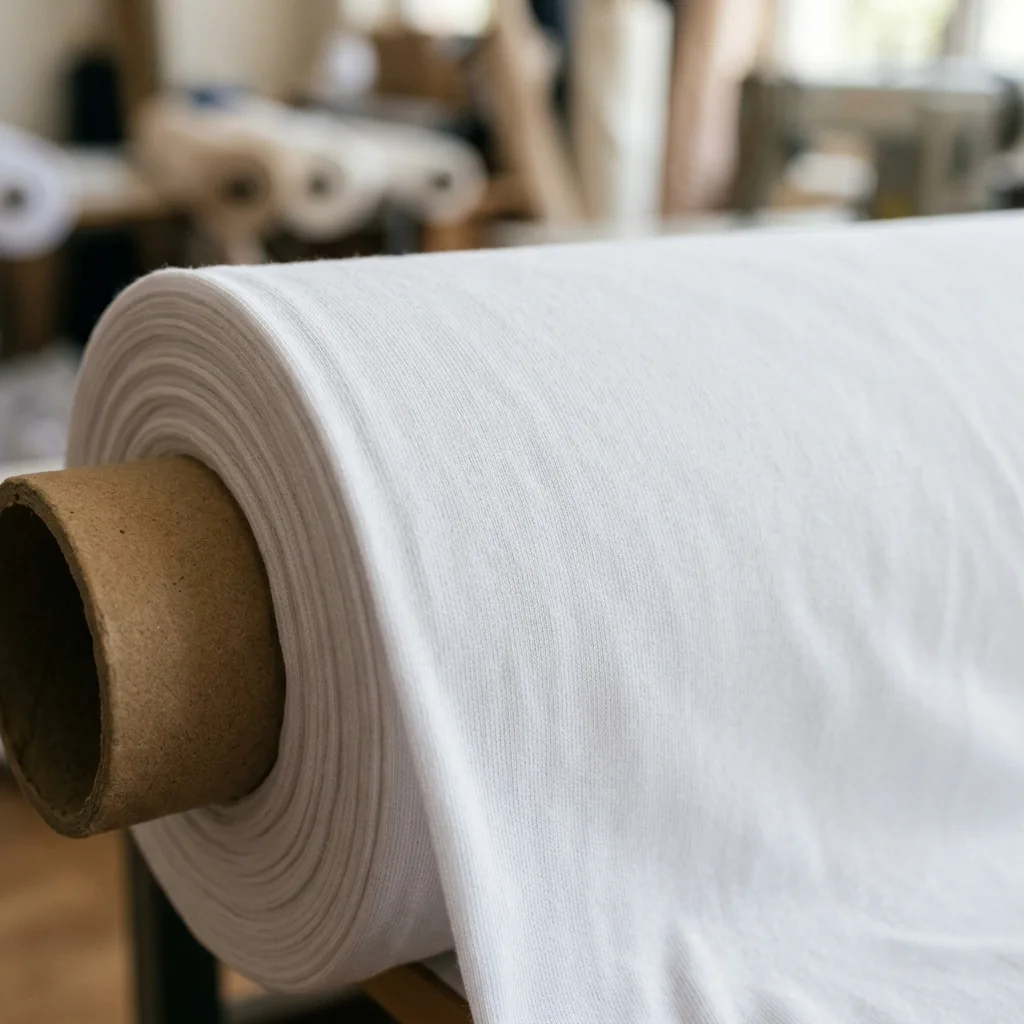
Knitted fabric: construction, weight and dimensional stability
Knitted fabric differs from woven fabric at a basic level. In weaving, warp and weft yarns cross each other at right angles; in knitting, a single yarn locks into itself as a series of loops. The stretch comes from that loop structure, even when there is no elastane in the blend. This is why t-shirts, underwear and activewear are knitted: the fabric follows the body without the fibers being pulled taut.
Single jersey, rib, interlock and french terry
Knitted fabrics are identified by their construction. Single jersey is produced on a single cylinder circular machine, with plain loops on the face and reverse loops on the back. It is light and forms the basis of the summer t-shirt. Rib and interlock are knitted on double cylinder machines, look similar on both sides and stretch far more across the width, which is why they are chosen for collars, cuffs and firmer underwear. French terry and fleece carry an extra yarn on the back, and brushing raises that yarn into a surface that traps air.
Machine gauge, the number of needles per inch, determines how fine the loop is. A higher gauge gives a finer, denser face; a lower gauge gives a thicker, bulkier fabric.
Yarn count alone does not set the fabric weight
The most common mistake in knitting is to tie fabric weight to yarn count alone. With the same yarn on the same machine, changing only the loop length produces noticeably different weights. A shorter loop makes the fabric denser, heavier and firmer; a longer loop makes it softer, more fluid and looser. When ordering, discussing yarn count, gauge and, where possible, loop length alongside the g/m² figure is the most practical way to avoid surprises on the second lot.
What to settle before placing the order
Most disputes over knitted fabric fall into three headings. The first is shrinkage: even after finishing and compacting, fabric changes dimension in washing, so the acceptable shrinkage range and the test wash it is measured against should be written down at the start. The second is spirality: in single jersey, the interaction between the twist direction of the yarn and the direction of knitting turns the fabric slightly, and the side seam of the finished garment drifts. Combed or compact yarn and correct setting reduce this risk.
The third is barré. Shade differences between yarn lots or between feeders appear as horizontal lines across the fabric, and often become visible only after dyeing. Wash, rubbing and perspiration fastness, along with pilling behavior, belong in the same conversation at the sampling stage. Bulk approval should not be given without a lab dip and roll inspection before cutting.
What to watch in a knitting order
Most disputes in knitted fabric start at the yarn, so the yarn lot and its properties matter as much as the construction. Yarn from different lots within the same order can become visible as barré after dyeing.
Alongside construction, weight, width and color, we recommend putting shrinkage allowance and fastness values in writing at sample approval. When rolls are weighed and recorded with their width, it becomes reasonable to expect every roll to behave the same way on the cutting table.