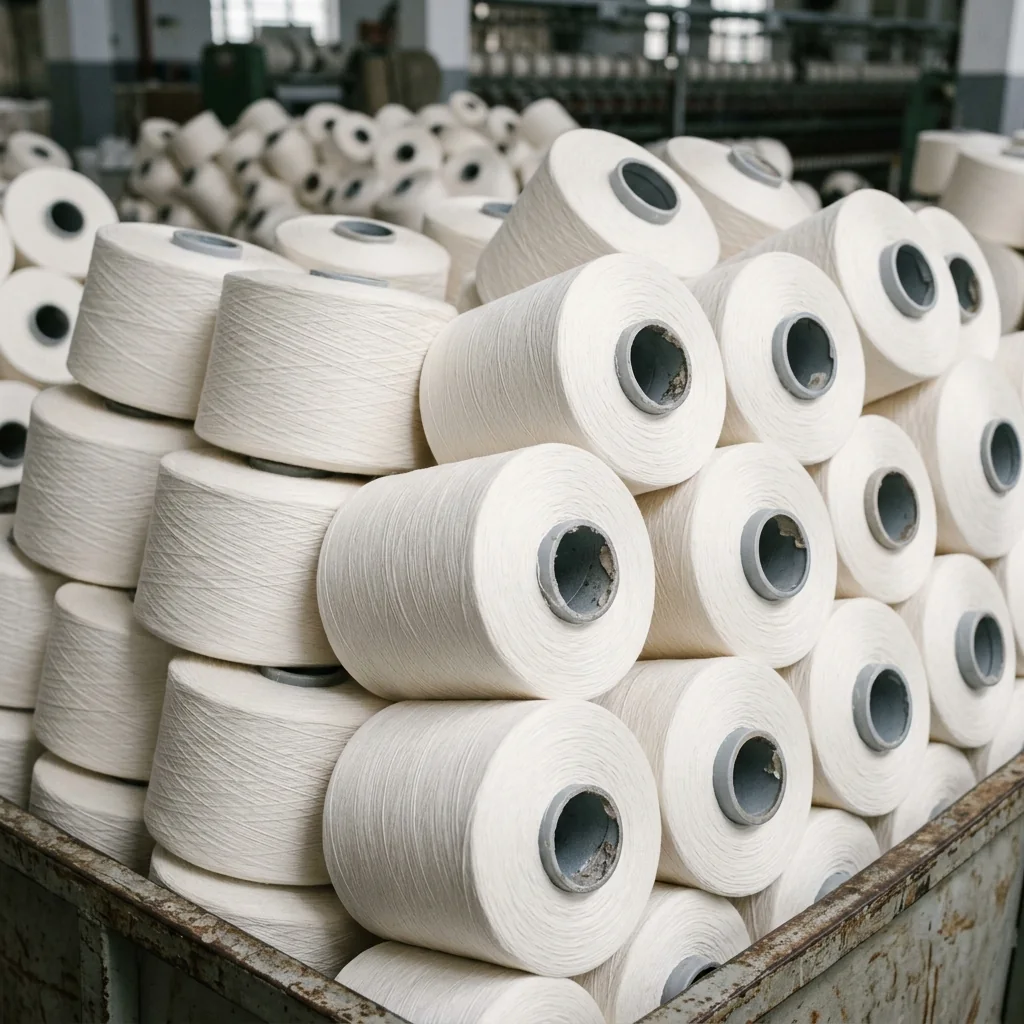
Cotton yarn: count, twist and spinning method
Cotton yarn is the last intermediate product on the road from fiber to fabric. A fabric's handle, dimensional stability, dye uptake and behavior on the machine are largely decided by the yarn's count, twist and evenness. For most buyers, choosing the yarn is a more consequential decision than choosing the fabric.
Reading count and twist
Yarn fineness is expressed as a count. The most common system in cotton is the English cotton count (Ne): how many 840 yard hanks make up one pound of yarn. The higher the number, the finer the yarn, so Ne 20 is coarse and Ne 40 is fine. Metric count (Nm) and the direct system tex are also used; tex is the weight in grams of 1000 meters, where a higher number means a thicker yarn. Stating the system in writing on the order prevents most later disputes.
Twist is the rotation that locks the fibers together, measured in turns per meter. As twist increases, strength rises up to a point, the yarn stiffens and the fabric gains body. Knitting yarns are spun with lower twist for a softer handle, while weaving warp yarns take higher twist to survive loom tension. Twist direction, Z or S, affects the fabric surface and belongs in the specification.
What the spinning method changes
In ring spinning the fibers are twisted continuously through a ring and traveler, producing a stronger, smoother and brighter yarn. In open-end (rotor) spinning the fibers are opened and collected in a rotor; the yarn is bulkier with good mass evenness, but weaker than ring yarn. Open-end is generally chosen in coarse and medium counts, for denim weft and home textiles where bulk and cost matter most.
In carded yarn the fibers only pass through the card. Combing removes short fibers and neps and leaves longer, more parallel fibers, so combed yarn suits finer counts and is less hairy. The waste separated at that stage is a commercial product in its own right. Compact spinning narrows the spinning triangle and reduces hairiness further.
What to check on delivery
The values to check on samples and incoming lots are well established: count deviation, evenness (U% or CV%), thin places, thick places and neps per kilometer, hairiness, breaking strength and elongation. The fiber sets the ceiling; staple length, strength, short fiber content and micronaire define what the yarn can reach before spinning begins.
In practice the most frequent problem is lot consistency. Yarn from different lots in one order can show up as barre after dyeing, particularly in knitted fabric. Cone weight, whether joins are knots or splices, waxing for knitting yarns and the conditioned moisture content also belong in the written delivery terms.
Working through samples
A yarn decision is better made on a sample than on paper. Target count, twist multiplier, spinning method and whether the yarn will run in weaving or knitting are the first points to settle. Once those are clear, expectations for evenness, hairiness and strength can be put in writing as well.
For buyers who send count, twist, end use and quantity, we come back with technical detail, lot documentation and samples. On knitting orders in particular, agreeing on lot continuity at the start prevents most of the problems that surface after dyeing.