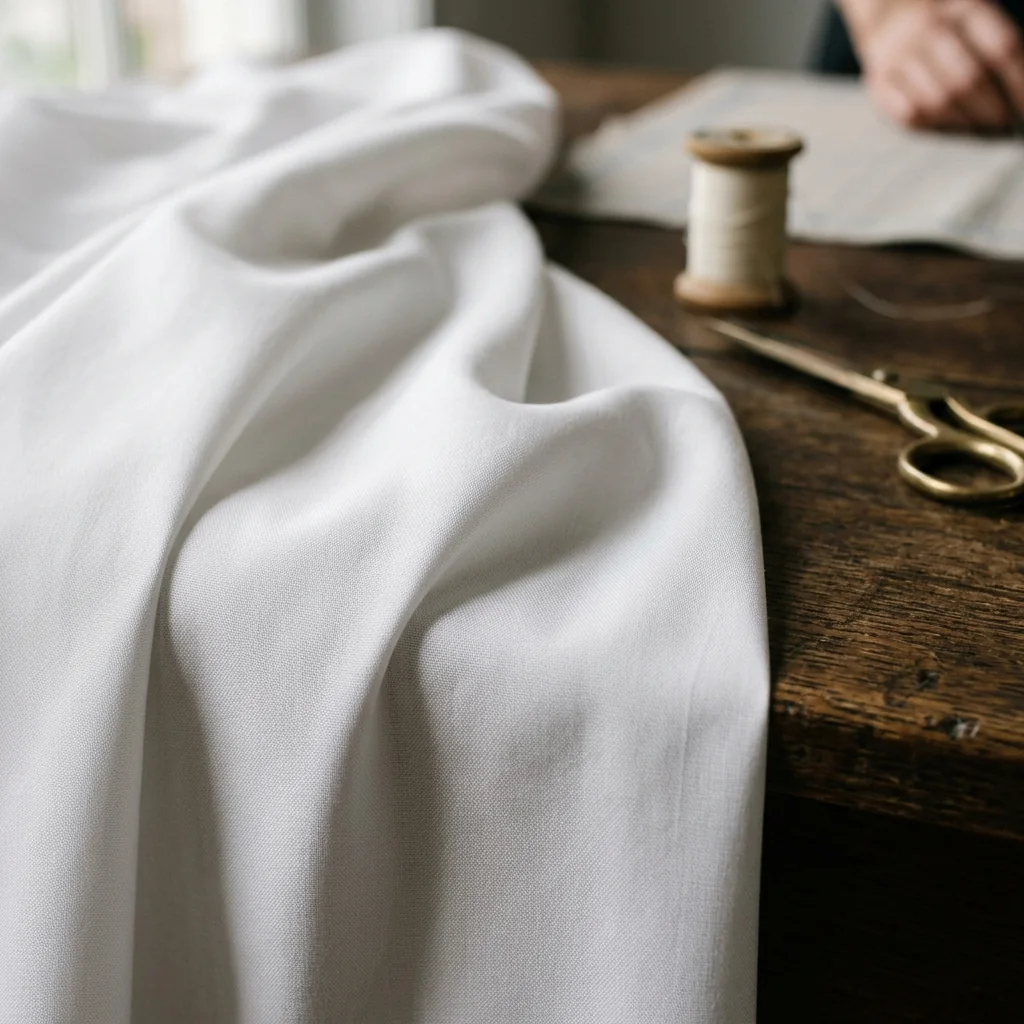
Reading woven fabric construction
Woven fabric is formed when two yarn systems cross at right angles in a defined order: the warp, tensioned lengthwise on the loom, and the weft, inserted across it. Hand-feel, strength, drape and cost all follow from the count, density and interlacing pattern of those two systems. No single property makes a woven fabric good or bad, what matters is whether the construction fits the end use.
The language of construction: count, density, weight
A woven fabric is usually described in a single line: warp and weft yarn count, warp and weft density, width and weight. A description such as Ne 30/1 x Ne 30/1, 110 x 70, 150 cm tells you most of how the fabric will behave before you handle it. The higher the count, the finer the yarn, and the higher the density, the firmer the fabric and the greater its weight.
Weight alone can be misleading. The same weight per square meter can be reached with coarse yarn woven openly or with fine yarn woven tightly, yet the two fabrics will not feel or wear the same. Yarn type matters here as well: a fabric woven from ring yarn gives a smoother, more lustrous surface, while open-end yarn leaves a bulkier, firmer structure.
What the weave type changes
Plain weave, where warp and weft alternate over and under, is the tightest interlacing. It gives poplin and shirting their flat surface and dimensional stability. In twill the binding points are offset, producing a diagonal line on the face. Twill constructions such as gabardine give softer drape and higher abrasion resistance at the same density, which is why they are chosen for trousers, jackets and outerwear. In sateen the yarn floats are long, giving a lustrous, fluid surface, but also making it more sensitive to rubbing and snagging.
From greige to finished fabric
Warp yarns face thousands of abrasion cycles on the loom, so they are sized before weaving. The greige fabric that comes off the loom then goes through desizing, bleaching, dyeing where required, and mechanical finishing. Each of these steps alters width, weight and shrinkage behavior, which is why measurements should always be discussed on the finished fabric.
Shrinkage is the item buyers most often overlook. A fabric that has only been bleached will not lose the same dimensions in washing as a sanforized one. Because it feeds directly into the cutting plan, the shrinkage tolerance and the wash conditions it was measured under should be put in writing before the order is placed.
What to settle before ordering
Finished width and weight tolerance, shrinkage values, the inspection standard to be applied and the acceptable point score, roll length and the number of joins allowed in a roll, shade variation within and between rolls, selvedge construction and usable width. Discussing these at sample approval removes most of the arguments that would otherwise come after shipment.
We work from the same construction specification from sample through to shipment: width, weight, sett and finishing steps are whatever was written at sample approval. Putting these in writing before the order largely removes the risk of the cloth not matching the cutting plan.